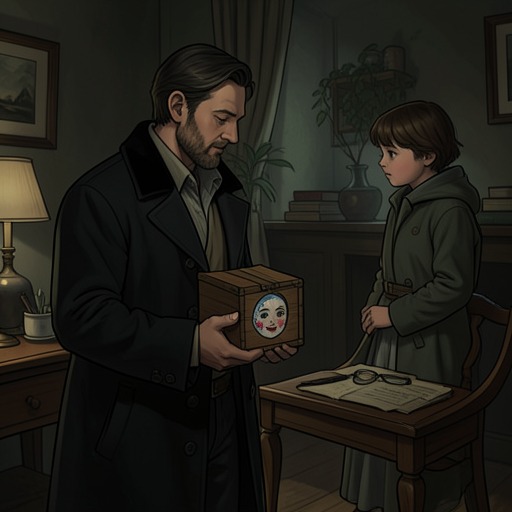
Pip discovers Estella’s parentage
Great ExpectationsPip discovers Estella’s parentage when a familiar gesture allows him to recognize her mother, and Herbert’s account of the woman’s past leads him to identify Magwitch as her father. The discovery overturns Pip’s assumptions about both Estella and his benefactor: Estella was the orphan Miss Havisham arranged to adopt, while Magwitch had once loved and lost a child whose mother concealed her. The revelation makes family identity a matter not only of blood, but also of secrets, legal arrangements, and the people who raise a child without knowing the whole story.
Recognition and the Hidden Connection
The recognition begins with a small physical detail. When the woman serving at the table withdraws her hands and steps back nervously, Pip notices the action of her fingers. He remembers that a similar link had helped identify her at the theatre; the association between her knitting gesture and attentive eyes now becomes decisive. He feels certain that she is Estella’s mother. Rather than arriving through a formal disclosure, the first part of the truth is assembled from observation and memory.
Her history makes that recognition consequential. Wemmick explains that, roughly twenty years earlier, the woman had been tried at the Old Bailey for murder and acquitted. After the trial she entered Mr. Jaggers’s service, where, Wemmick says, she was already subdued. Her past is therefore known in fragments through the legal world around Mr. Jaggers, but her connection to Estella is not yet explained by those fragments alone.
Herbert’s Account and the Parentage Revelation
Herbert supplies the missing family history while helping Pip recover from his burns. He describes the woman as young, jealous, and revengeful, and recounts that she and Provis had a little child for whom Provis was deeply fond. On the night the woman’s rival was murdered, she came to Provis, swore that she would destroy the child in her possession and that he would never see the child again, and then disappeared. Herbert’s account links the woman’s violent past to a lost child, but Pip must still establish that this child is Estella.
The crucial identification comes when Pip says that the man hidden down the river is Estella’s father. He names him as Provis, from New South Wales. Mr. Jaggers’s response confirms that he understands the claim and asks whether Pip knows the young lady’s father. The revelation is not simply that Estella has living parents: it is that Magwitch, the hidden man whom Pip has been protecting, is one of them. Herbert’s account supplies the history; Pip’s recognition and disclosure connect it to the present.
Adoption, Legal Secrecy, and Unshared Knowledge
Mr. Jaggers does not offer a direct confession. Instead, he asks Pip to consider a case in which a mother in difficult circumstances conceals her child, then has to disclose the child’s existence to her legal adviser so he can understand the position in preparing her defence. At the same time, that adviser holds a trust to find a child for an eccentric wealthy woman who wants to adopt one. The circumstances bring the woman’s hidden child, Mr. Jaggers’s legal work, and Miss Havisham’s search for an adopted daughter into the same chain of events.
Mr. Jaggers extends the hypothetical: the child grows up and marries for money; both parents remain alive, but they do not know one another, and the secret remains a secret except for what Pip has discovered. His careful framing distinguishes what he can acknowledge from what he chooses not to state outright. Pip, meanwhile, is certain that Mr. Jaggers did not know who Estella’s father was. He had suspected this from Provis’s account and from the timing of Provis’s later relationship with Mr. Jaggers, but the lawyer’s attentive pause when Pip names Provis makes that uncertainty seem settled to him.
The adoption itself had begun with Miss Havisham’s request. After she had been shut away in her rooms for an indeterminate period, she asked Mr. Jaggers to find a little girl whom she could rear and love, and whom she could save from her own fate. Mr. Jaggers brought the child to her asleep one night, and Miss Havisham named her Estella. The scene reveals a stark difference between the intended emotional meaning of adoption and the life Estella subsequently experienced: Miss Havisham chose her as a child to love and raise, while Estella’s birth parents remained outside the family she knew.
Consequences for Pip’s Understanding
The new knowledge changes the meaning of Magwitch’s return and of Pip’s attachment to Estella. Pip had already loved her despite knowing that his love was unreasonable and opposed to his hopes. He also recalls the first pain of learning that Miss Havisham had not intended Estella for him: he had been only a convenient instrument, a model on which to practise, and a means of wounding Miss Havisham’s greedy relations. Most painful, he had abandoned Joe while imagining that a convict, guilty of unknown crimes and liable to execution, might be taken from the rooms where Pip sat thinking. Learning Estella’s parentage places the hidden family past beside these earlier misunderstandings; it does not erase the harm Pip recognizes in his own choices.
The revelation also clarifies the difference between biological kinship and family life in the story. Miss Havisham selected and raised Estella without knowing her complete parentage; Magwitch loved a child he lost and did not know had grown up as Estella; and the woman who bore her lived under the protection and employment of the lawyer who arranged the adoption. The parents’ survival does not restore a shared household or give them a common history. Instead, the truth reaches Pip through a gesture, a friend’s account, and a lawyer’s carefully constructed hypothetical—knowledge that had remained divided among people living within reach of one another.
Narrative Significance
Because Pip narrates retrospectively, the discovery is staged as a gradual correction rather than an immediate explanation. First comes the remembered gesture; then Wemmick’s account of the woman’s acquittal and employment; then Herbert’s history of the child; finally Pip’s identification of Provis and Mr. Jaggers’s response. The sequence lets the reader follow how separate clues acquire meaning, while keeping the parents’ relationship to Estella concealed until Pip can connect them.
The episode also sharpens the novel’s contrast between social identity and hidden descent. Estella’s upbringing and marriage have taken place without knowledge of the parents whose histories the revelation joins. The truth makes her position legible to Pip, but it cannot undo the years in which adoption, secrecy, and the expectations of others shaped her life. Family connection is disclosed at last as a fact; the relationships formed in its absence remain part of its consequence.